When Nation-States Target Your Protocol: Inside Lazarus Group's War on DeFi

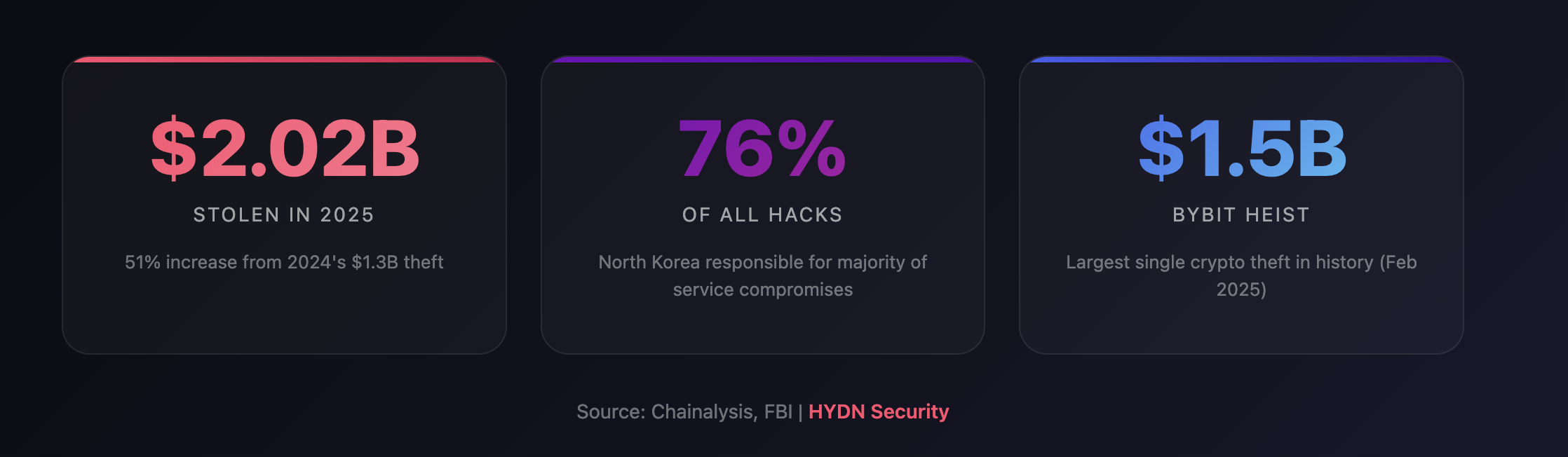
When we talk about Lazarus GroupDeFi attacks, we're not discussing theoretical risks. In February 2025, NorthKorea's Lazarus Group executed the largest cryptocurrency heist in history:$1.5 billion stolen from Bybit in a single operation. They didn't exploit asmart contract vulnerability. They didn't find a bug in the code. Theycompromised the humans and systems surrounding the protocol's multi-signaturewallet infrastructure.
This wasn't an anomaly. It was theculmination of a decade-long campaign. According to Chainalysis, North Koreanthreat actors stole at least $2.02 billion in cryptocurrency in 2025alone—accounting for 76% of all service compromises globally. The cumulativetotal now exceeds $6.75 billion.
Most security audits focus oncode. Lazarus Group focuses on people, processes, and the systems that connectthem. And they're winning.
At HYDN, we've spent yearsstudying and defending against APT groups including Lazarus, MuddyWater, andKasablanka. This isn't theoretical knowledge—it's operational experience.Here's what every protocol team needs to understand about the threat landscapein 2026.
Lazarus Group operates under NorthKorea's Reconnaissance General Bureau (RGB), the country's primary intelligenceagency. Unlike financially-motivated criminal hackers, Lazarus serves stateobjectives: circumventing international sanctions, funding weapons programs,and accessing global financial systems that are otherwise blocked.
This distinction matters. Criminalhackers optimize for efficiency. They hit easy targets, grab what they can, andmove on. State-sponsored actors optimize for impact. They're patient. They'rewell-resourced. They'll spend months—sometimes years—positioning themselves fora single high-value operation.
The Bybit hack wasn't asmash-and-grab. It was the result of extensive reconnaissance, careful socialengineering, and exploitation of trust relationships within the organization'ssecurity infrastructure.
Lazarus doesn't start with yourcode. They start with your people.
The "ContagiousInterview" Campaign
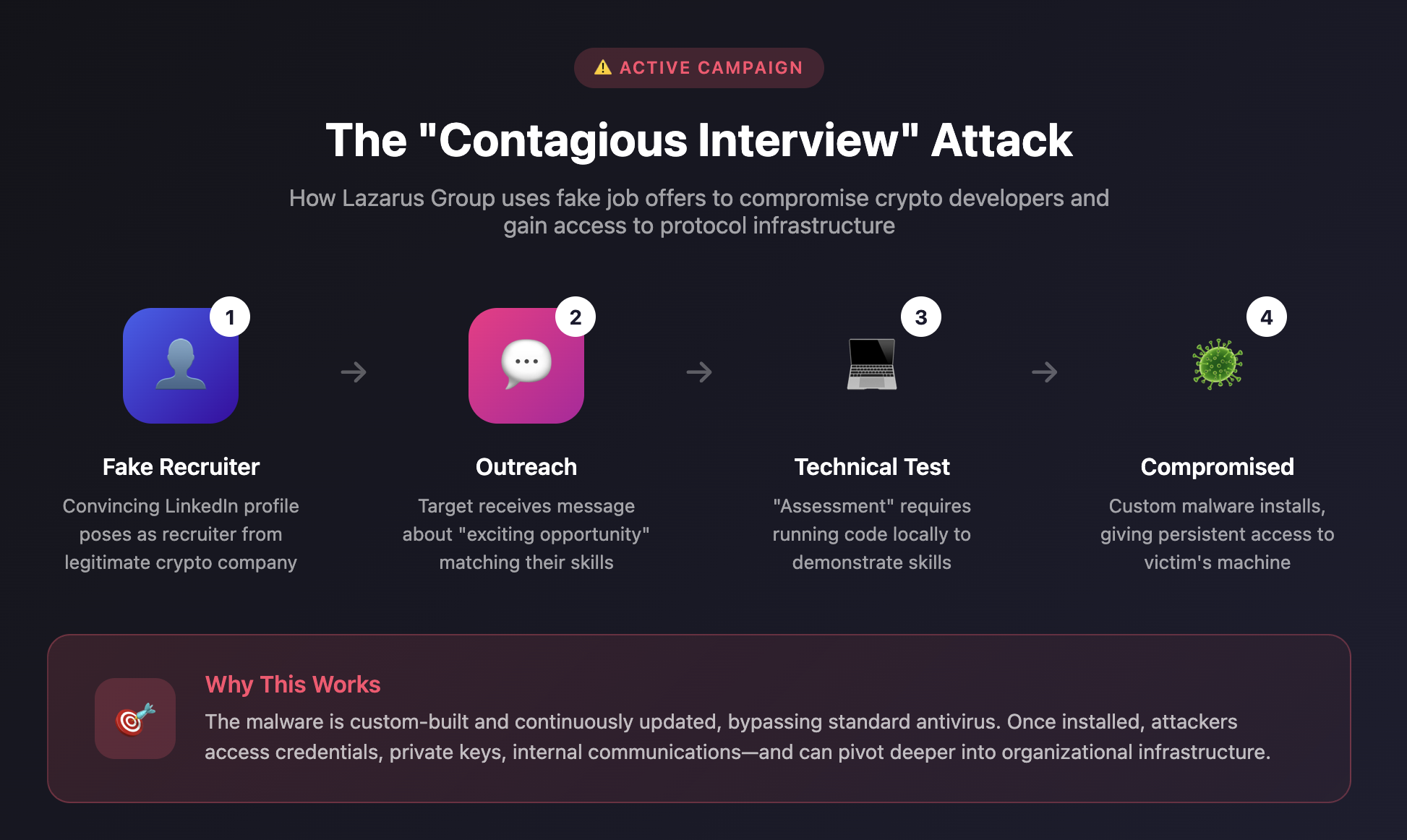
One of Lazarus's most effectivetactics is a sophisticated fake recruitment operation. Here's how it works:
1. Threat actors createconvincing LinkedIn profiles posing as recruiters from legitimate cryptocompanies
2. They reach out todevelopers, security engineers, and operations staff at target organizations
3. Candidates are invited tocomplete "technical assessments" that require running code locally
4. The assessment containsmalware that establishes persistent access to the victim's machine
This campaign has targetedhundreds of cryptocurrency professionals globally. The malware isn't detectedby standard antivirus because it's custom-built and continuously updated. Onceinstalled, attackers have access to everything on that machine: credentials,private keys, internal communications, and the ability to pivot deeper intoorganizational infrastructure.
Watering Hole Attacks
Lazarus also compromises websitesfrequented by their targets. In the "SyncHole" campaign (2024-2025),they exploited zero-day vulnerabilities in mandatory financial software used inSouth Korea. Visitors to compromised sites had malware silently installedwithout any user interaction.
For DeFi protocols, the equivalenttargets are developer forums, documentation sites, and tooling repositories. Ifyour team visits a compromised site, you may already be compromised—and youwon't know it.
Once Lazarus has a foothold insidean organization, they move laterally with patience and precision.
Targeting Multi-SignatureInfrastructure
The Bybit hack specificallytargeted Safe{Wallet}, a widely-used multi-signature wallet solution. Lazarusdidn't break the cryptography—they compromised the systems used to initiate andapprove transactions.
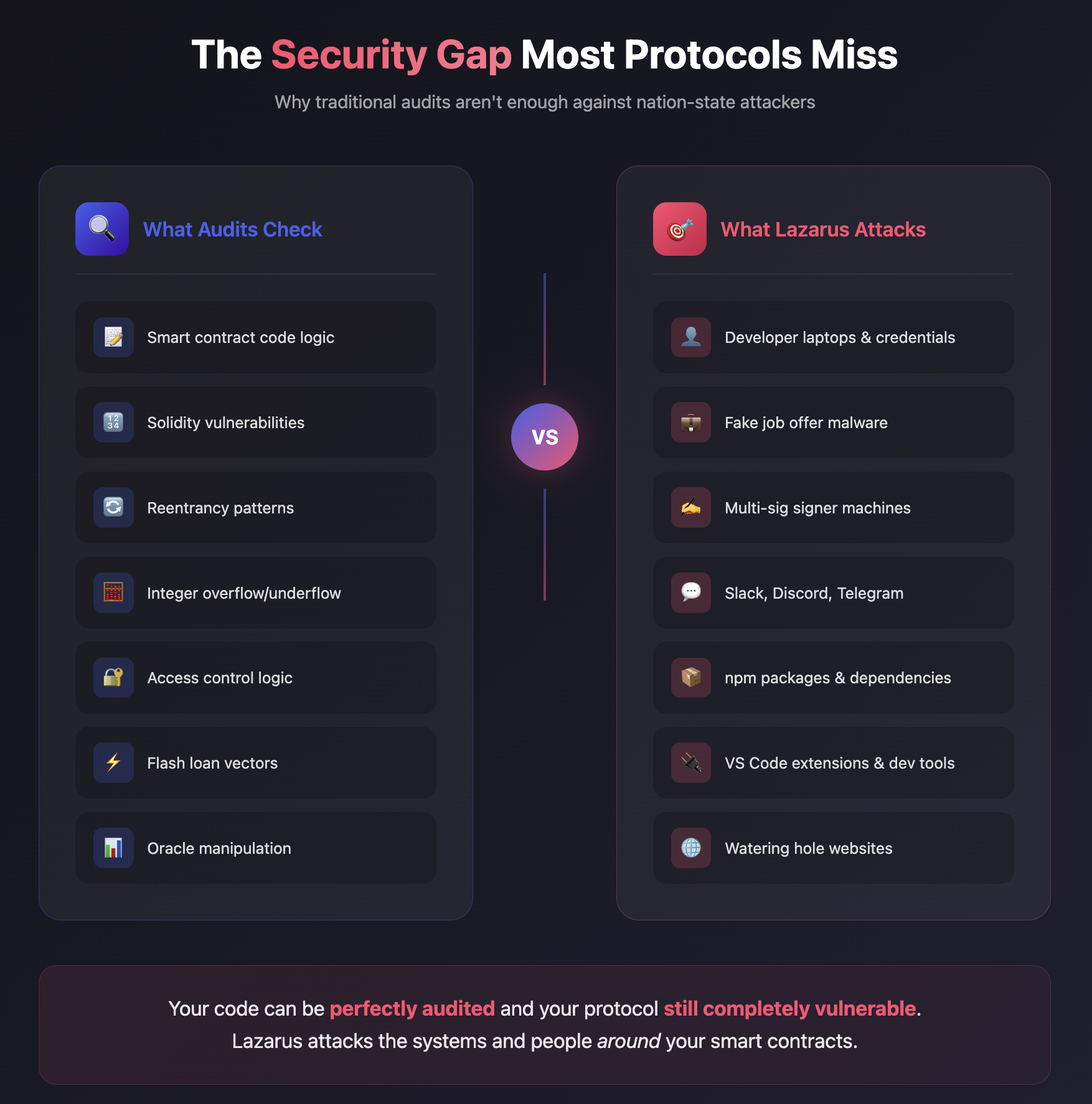
This is a critical lesson: yoursmart contracts can be perfectly audited, your Solidity flawless, and yourprotocol still completely vulnerable. The attack surface extends to everysystem that touches your treasury operations: the computers used to sign transactions,the communication channels used to coordinate approvals, and the operationalprocedures that govern fund movements.
Supply Chain Attacks
Lazarus increasingly targets thedependencies and tools that protocols rely on. A compromised npm package, amalicious VS Code extension, or a backdoored development tool can provideaccess to dozens of downstream targets. This is efficient at scale: compromiseone widely-used tool, gain access to hundreds of potential victims.
When Lazarus executes, they movefast. The Bybit operation extracted $1.5 billion before the organization fullyunderstood what was happening.
Money LaunderingInfrastructure
The stolen assets follow astructured laundering pathway over approximately 45 days:
• Days 0-5 (ImmediateLayering): Funds are dispersed acrossthousands of wallets and run through DeFi protocols and mixing services
• Days 6-10 (Cross-ChainMovement): Assets move through bridgesand exchanges to obscure the trail
• Days 20-45 (Conversion):Final conversion to fiat currencythrough complicit or unwitting exchange accounts
By the time most organizationshave completed incident response, the funds are already converted and largelyuntraceable.
Understanding the evolution ofLazarus Group DeFi targeting is crucial for protocol teams. In 2024-2025,Lazarus shifted their primary focus from DeFi protocols to centralizedexchanges. Four of their five most recent major hacks targeted centralized virtualasset service providers (VASPs).
This might seem like good news forDeFi. It isn't.
Centralized exchanges representhigher-value, more concentrated targets. But the tactics Lazarus developedagainst DeFi—social engineering, multi-sig compromise, supply chain attacks—areequally effective against protocols. The shift in targeting reflectsopportunity, not capability.
More importantly, DeFi protocolsare increasingly integrated with centralized services. Your bridge relies onexternal validators. Your oracle network has centralized components. Yourtreasury operations involve multisig setups with human signers.
Every one of these integrationpoints is a potential attack vector for a well-resourced nation-state actor.
Based on our experience defendingagainst APT groups, here are the security controls that make a materialdifference:
Traditional security asks:"How do we prevent attackers from getting in?" APT-resistant securityasks: "When attackers get in, how do we limit the damage?"
Practical Implementation:
• Segment access so that nosingle compromised credential grants access to treasury operations
• Require out-of-bandverification for high-value transactions (phone call confirmation, separatecommunication channel)
• Implement time delays onlarge transfers that allow for human intervention
• Maintain cold storagereserves that require physical, in-person access to move
Your developers are targets. Youroperations team are targets. Your contractors are targets.
Practical Implementation:
• Security awareness trainingspecifically focused on crypto-targeting social engineering
• Strict policies aboutrunning code from external sources (including "technical assessments"from recruiters)
• Hardware security keys forall authentication—no SMS, no TOTP apps on potentially compromised phones
• Regular review of who hasaccess to what, with aggressive de-provisioning when roles change
Every dependency is a potentialattack vector.
Practical Implementation:
• Lock dependency versionsand review all updates before deployment
• Use reproducible builds toverify that deployed code matches audited source
• Audit your developmentenvironment: browser extensions, IDE plugins, CLI tools
• Consider air-gappedmachines for signing operations
You can't prevent every intrusion.You need to know when you've been compromised.
Practical Implementation:
• Monitor for anomalousaccess patterns in your infrastructure
• Implement canary tokens andtripwires that alert on unauthorized access
• Regular threat huntingexercises that look for indicators of APT activity
• Incident response plansthat assume state-sponsored adversaries
A smart contract audit verifiesyour code. But Lazarus doesn't attack your code—they attack the systems andpeople around it.
Practical Implementation:
• Red team exercises thatsimulate social engineering attacks against your team
• Operational securityassessments that evaluate your transaction signing workflows
• Third-party reviews of yourmulti-sig and treasury management procedures
• Tabletop exercises thatwalk through APT-style attack scenarios
The cryptocurrency industry hashistorically treated state-sponsored attacks as theoretical or distant threats.But the reality of Lazarus Group DeFi operations is now impossible to ignore.The 2024-2025 campaign by Lazarus Group has made clear that this threat isimmediate, material, and affecting the largest organizations in the space.
$6.75 billion stolen. The largestsingle theft in history. 76% of all service compromises attributed to a singlenation-state actor.
This isn't a problem that getssolved by better smart contract audits alone. It requires a fundamentalexpansion of how protocols think about security—from code correctness tooperational resilience against sophisticated, patient, well-resourced adversaries.
At HYDN, we bring a differentperspective to protocol security. Our team includes researchers with directoperational experience against APT groups including Lazarus, MuddyWater, andKasablanka.
We don't just audit your smartcontracts. We assess your entire security posture: the systems that supportyour protocol, the operational procedures that govern high-value transactions,and the human factors that sophisticated attackers exploit.
If you're building infrastructurethat will hold significant value, you need security that accounts for the fullthreat landscape—including nation-state adversaries.
Ready to assess your protocol'sresilience against state-sponsored threats? ContactHYDN for a security consultation.
5. Lazarus Group stole$2.02 billion in crypto in 2025—morethan half of all cryptocurrency theft globally
6. They don't attack code;they attack people and systems. Socialengineering, supply chain compromise, and operational security failures aretheir primary vectors
7. The Bybit hack ($1.5B)exploited multi-sig infrastructure, notsmart contract vulnerabilities
8. Traditional securityaudits are necessary but insufficient. Protocolsneed operational security assessments, red team exercises, and APT-awaredefensive measures
9. HYDN brings operationalAPT experience that most security firmscan't match—because we've been on the front lines against these groups
HYDN Security provides smart contract audits, penetrationtesting, and red team services for Web3 protocols and DeFi projects. Our teamhas protected organizations against threats from Lazarus Group, Kasablanka,MuddyWater, and other advanced persistent threat actors. Learn more athydnsec.com.


.svg)


