OWASP Smart Contract Top 10 2026: What the Changes Tell You About Where Attacks Are Heading

The 2026 list landed in February. The vulnerabilities that moved up matter more than the ones that stayed.
OWASP published the Smart Contract Top 10 for 2026 last month, the most authoritative ranking of smart contract security vulnerabilities 2026 has seen, built from 122 real-world incidents and $905 million in losses. For any team auditing smart contract security vulnerabilities in 2026, this is the benchmark to map against. And this year, the changes between editions are more instructive than the list itself.
Here is what moved, what got cut, and what it means for protocols shipping in 2026.
Insecure Randomness and Denial of Service Attacks were both dropped from the 2026 list. Not because they disappeared, but because the industry got meaningfully better at handling them. Tooling improved. Developer awareness caught up. The ecosystem applied the lessons.
This is what a maturing security landscape looks like. Yesterday's #1 becomes today's table stakes.
The same thing is happening with Reentrancy Attacks, which dropped from #5 to #8. The DAO hack put reentrancy on everyone's radar in 2016. A decade later, it is reliably caught by static analysis tools, auditors, and developers who know what to look for. Progress is real.
But as defenders get better at the basics, attackers move up the stack. And the 2026 list shows exactly where they went.
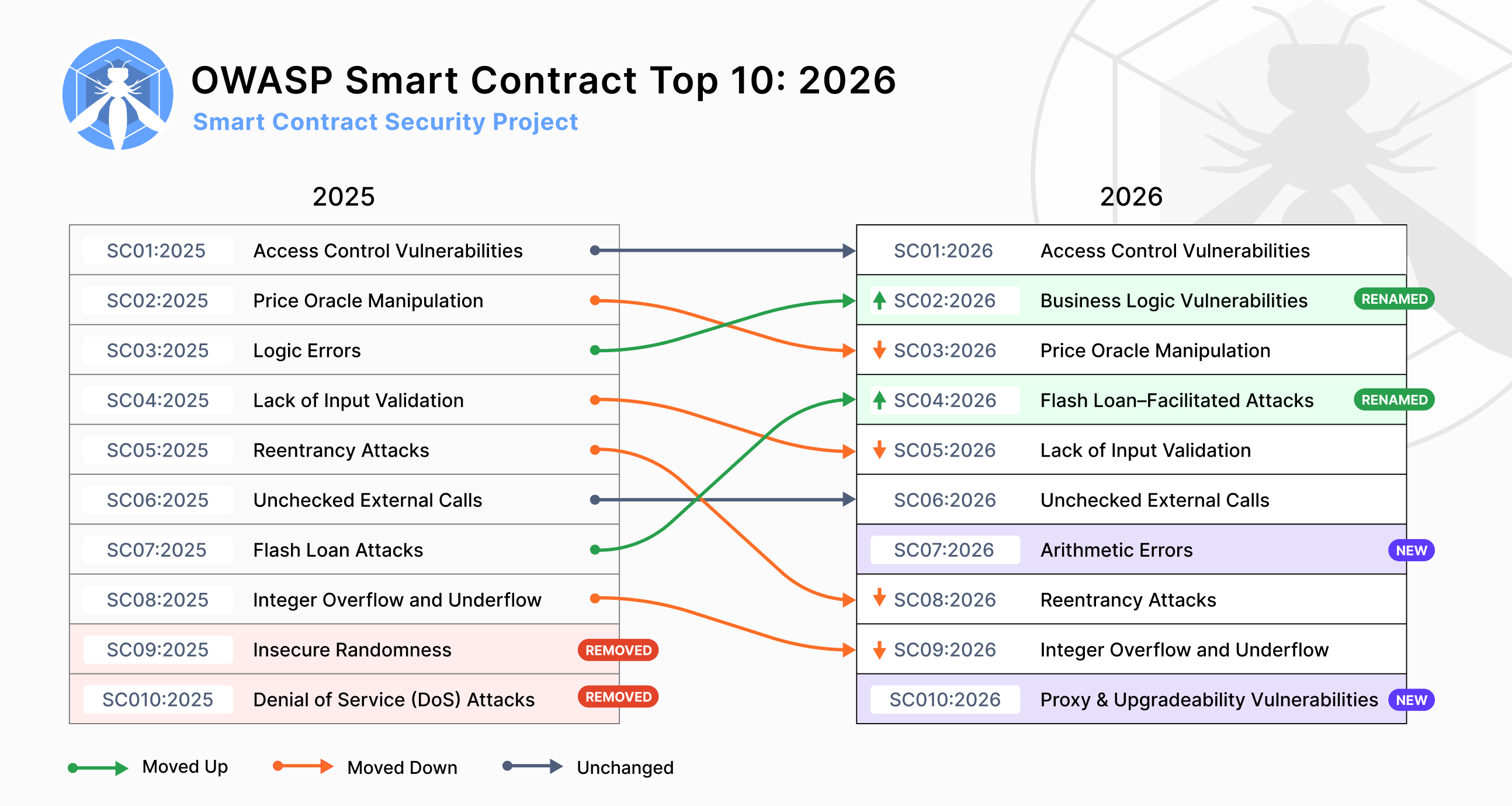
Access Control Vulnerabilities held at #1 for the second year running. Misconfigured admin functions, exposed governance paths, broken upgrade permissions. The most exploited attack surface in Web3 has not moved because protocols keep getting it wrong.
Business Logic Vulnerabilities jumped from #3 to #2, and were renamed from "Logic Errors" in the process. The rename is deliberate. These are not bugs in the traditional sense. They are flaws in how a protocol was designed: lending logic that breaks under adversarial conditions, governance mechanisms that can be manipulated, economic assumptions that look correct until a motivated attacker models the incentives properly. You cannot lint your way to finding these. They require someone who understands the protocol well enough to think like an attacker.
Flash Loan-Facilitated Attacks rose from #7 to #4, also renamed. Previously listed as "Flash Loan Attacks," the new name reflects a more accurate understanding of the vector. Flash loans do not create vulnerabilities. They give attackers uncollateralized capital, sometimes hundreds of millions of dollars, to amplify vulnerabilities that already exist. The flaw is always somewhere else: in the oracle design, the governance logic, or the arithmetic. The flash loan is the weapon, not the wound.
Arithmetic Errors enters at #7 as a brand new category. Precision loss in share calculations, interest accrual, and AMM math. These bugs are subtle, repeatable, and particularly dangerous when paired with flash loans that let attackers exploit rounding errors across thousands of transactions in a single block.
Proxy and Upgradeability Vulnerabilities enters at #10, also new. As more protocols ship upgradeable contracts, the security of the upgrade mechanism itself becomes a critical attack surface. Misconfigured proxies, storage collisions, unprotected initializers, and weak governance controls over who can trigger an upgrade. Teams invest heavily in auditing contract logic and then leave the upgrade path effectively unguarded.
The 2026 edition reflects a clear shift in the threat landscape. The attacks at the top of the list are no longer about finding implementation bugs in well-understood code patterns. They are about exploiting architectural decisions: how access is governed, how prices are sourced, how economic logic holds up under adversarial pressure, how upgrade authority is controlled.
This has real implications for how security reviews need to be structured. A tool that catches reentrancy and integer overflows is necessary but no longer sufficient. The vulnerabilities driving the biggest losses require reviewers who can reason about intent, model attacker economics, and stress-test the assumptions built into a protocol's design.
The full list is publicly available at owasp.org/www-project-smart-contract-top-10. Map your architecture against it before you ship.
At HYDN, we conduct smart contract audits that go beyond pattern-matching, combined with penetration testing and red team operations covering the full attack surface. If you want a security review built around how attackers actually think, get in touch.


.svg)